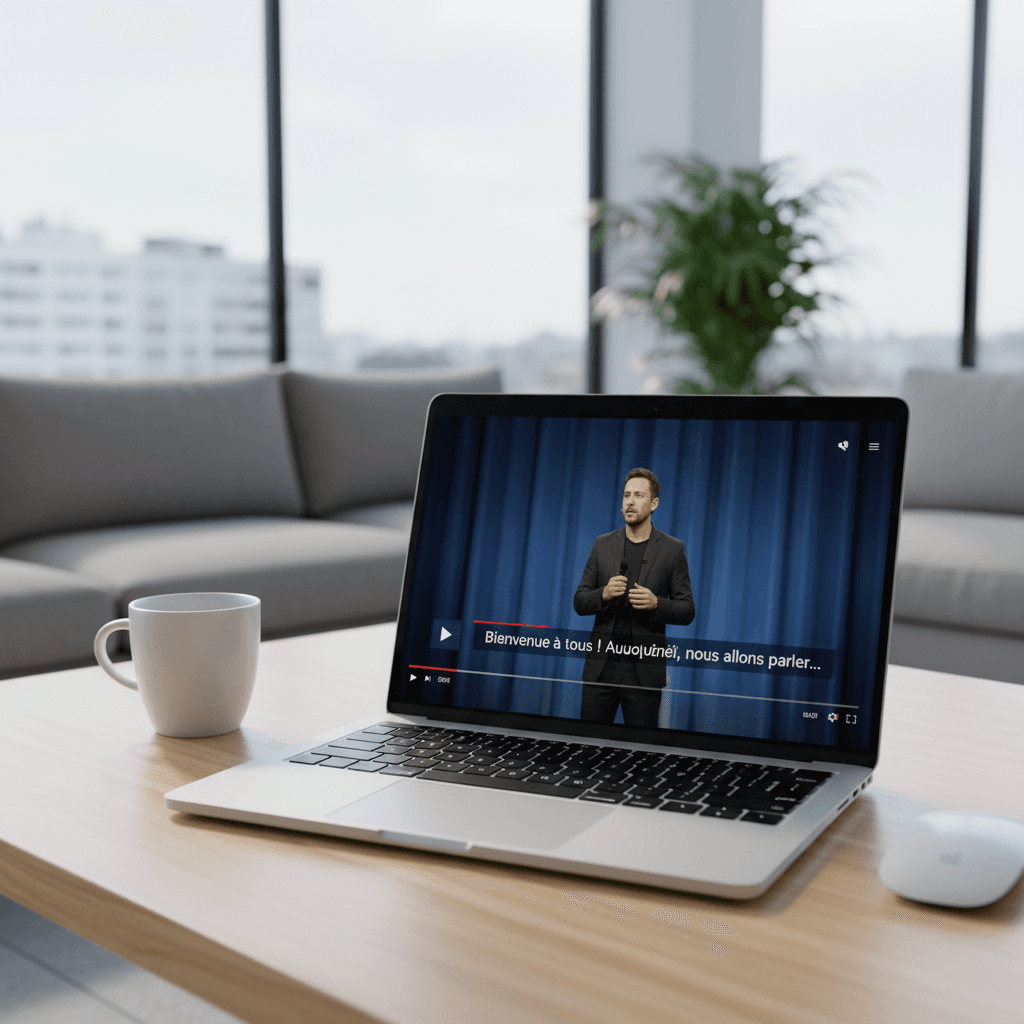
Top 10 AI Subtitle Generation Apps
Artificial intelligence is revolutionizing video content creation, and automatic subtitle generation is no exception. Whether you're a content creator, business, or individual, these tools are dramatically transforming how we make our videos accessible and multilingual.
AI-powered automatic transcription now enables the generation of accurate subtitles in just minutes, where previously it required several hours of manual work. This technology relies on increasingly sophisticated video speech recognition algorithms.
How does AI subtitle generation work?
AI subtitle tools use deep neural networks to analyze video audio tracks. The process breaks down into several steps:
- Audio extraction: The AI isolates the video's soundtrack
- Speech recognition: Conversion of sounds into raw text
- Time synchronization: Precise alignment of text with speech moments
- Contextual correction: Accuracy improvement through context
- Formatting: Generation of the final subtitle file
This automated approach now achieves accuracy rates exceeding 90% for French content, thus revolutionizing AI video subtitling.
1. Zorgsubtitle.com - The French reference solution
Zorgsubtitle.com stands out as one of the most powerful platforms in the French market. This specialized solution offers an intuitive interface perfectly adapted to the needs of French-speaking creators.
Main features:
- 100% French interface
- Support for over 15 European languages
- Transcription accuracy above 92%
- Export in SRT, VTT, and TXT formats
- Flexible per-minute pricing
Specific advantages:
The platform particularly excels in recognizing French regional accents and offers specialized linguistic models for different business sectors. Its collaborative correction system allows users to continuously improve transcription accuracy.
2. Rev.com - Professional precision
Rev.com combines artificial intelligence and human review to guarantee exceptional quality. This hybrid approach makes it a preferred choice for demanding professional content.
Strengths:
- 99% accuracy guaranteed with human review
- Maximum delivery time of 12 hours
- Support for 36 languages
- Robust API for integration
3. Otter.ai - Meeting specialist
Otter.ai has established itself as the reference for meeting and conference transcription. Its AI excels in distinguishing multiple speakers.
Distinctive features:
- Automatic speaker identification
- Intelligent summaries of key points
- Zoom, Teams, Google Meet integration
- Advanced search in transcriptions
4. Descript - Integrated video editing
Descript revolutionizes video editing by allowing videos to be edited like a text document. This unique approach greatly facilitates AI subtitle creation.
Notable innovations:
- Video editing through transcribed text modification
- Automatic removal of "ums" and pauses
- Voice cloning for corrections
- Real-time collaboration
5. Happy Scribe - European versatility
Happy Scribe positions itself as a comprehensive solution for the European market, with particular attention to regional linguistic nuances.
Main assets:
- Support for 120+ languages and dialects
- European accent recognition
- Advanced collaboration tools
- Strict GDPR compliance
6. Sonix - Advanced contextual intelligence
Sonix uses contextual learning algorithms that adapt to the specific vocabulary of each business domain.
Technical specifications:
- Automatic adaptation to technical vocabulary
- Automatic language detection
- Semantic search in transcriptions
- Export to 40+ formats
7. Trint - Journalistic collaboration
Initially designed for journalists, Trint offers particularly sophisticated verification and annotation features.
Specialized tools:
- Integrated fact-checking system
- Precise time annotations
- Multi-level validation workflows
- Sensitive source protection
8. AssemblyAI - Developer API
AssemblyAI targets developers with a powerful API allowing transcription integration into custom applications.
Technical capabilities:
- Automatic topic detection
- Real-time sentiment analysis
- Automatic content moderation
- Enterprise scalability
9. Speechmatics - Industrial precision
Speechmatics distinguishes itself through its ability to process variable-quality audio content, ideal for industrial environments.
Technical robustness:
- Resistance to ambient noise
- Real-time processing
- Support for 34 languages
- On-premise deployment possible
10. Amberscript - Educational solution
Amberscript has specialized in the education sector with features adapted to pedagogical needs.
Educational features:
- Automatic course summary generation
- Content-based quiz creation
- Collaborative pedagogical annotations
- Accessibility standards compliance
Selection criteria for AI subtitling tools
Choosing an automatic subtitling software depends on several essential factors:
Linguistic accuracy
Speech recognition quality varies considerably depending on the source language. For French, prioritize solutions offering specialized linguistic models.
Output formats
Check compatibility with your distribution platforms. SRT, VTT and SBV formats cover the majority of needs.
Multilingual capabilities
For automatic multilingual subtitling, evaluate the number of supported languages and automatic translation quality.
Technical integration
The existence of APIs facilitates integration into existing workflows, particularly important for French AI video tools.
Practical applications by sector
Education sector
Educational institutions use these tools to make online courses accessible to hearing-impaired students. Automatic subtitle generation also enables the creation of multilingual learning materials.
Digital marketing
Marketers leverage YouTube AI subtitles to improve their video SEO and reach international audiences.
Medical sector
Automatic transcription of consultations or medical training requires exceptional terminological precision, justifying the use of specialized solutions.
Events
Conferences and webinars benefit from real-time subtitling, significantly improving accessibility and participant engagement.
Technological evolution and prospects
The future of automatic subtitling is moving toward deeper integration with emerging technologies. Similar to advances in robotics with innovations like Tesla Optimus Gen 3) or developments in Boston Dynamics Atlas Commercial), transcription AI benefits from constant progress in machine learning.
Next-generation linguistic models promise even finer contextual understanding, drastically reducing transcription errors. This evolution parallels that observed in other AI domains, from robotic assistants) to advanced speech recognition systems.
Cost optimization and ROI
Adopting AI subtitling tools generates measurable return on investment. Comparative analysis reveals that automatic transcription costs on average 5 to 10 times less than traditional manual subtitling.
ROI calculation:
- Time savings: 80% reduction in production time
- Cost reduction: 70-90% savings compared to manual subtitling
- Accessibility improvement: Measurable increase in video engagement
- International expansion: Facilitated multilingual deployment
This economic efficiency explains the massive adoption of these technologies, comparable to the enthusiasm observed for other AI innovations in various sectors, from commercial robotics) to automated content creation tools.