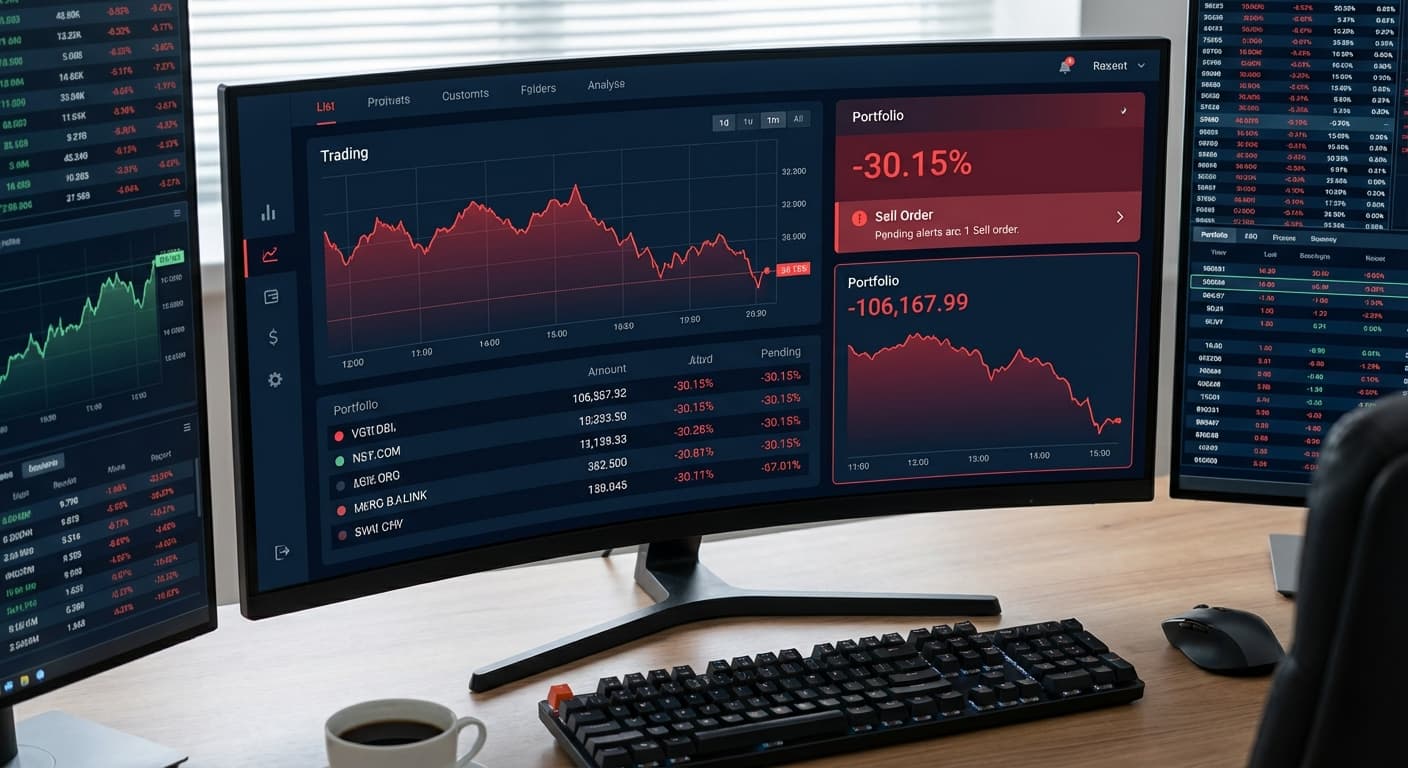
The world of trading glitters with promise: financial independence, quick profits, the adrenaline of the markets. For the beginner, it's a fascinating new universe, but also a psychological minefield. Because the trader's greatest battle is not against the market, but against themselves. Charts, indicators, and strategies are tools, but the real drivers of your decisions are your emotions, your biases, and your discipline.
Forget the image of the Wolf of Wall Street shouting into his phone. Successful trading is often calm, methodical, and, dare we say, a bit boring. Excitement is a sign that you're probably gambling, not investing. This guide delves into the most common trading mistakes made by beginners, focusing on the psyche and emotions—those invisible forces that dictate your losses and gains.
The Illusion of Easy Money: The First Mirage
The first, and perhaps most fundamental, mistake is believing that trading is a way to get rich quick. Fueled by social media where influencers show off staggering gains on cryptocurrencies or "meme stocks," this illusion is poison.
The Dopamine and Overconfidence Trap
When you're starting out, it's possible to make a few winning trades by pure luck. Each win triggers a release of dopamine in your brain, the same neurotransmitter associated with pleasure and reward. The danger? Your brain starts to associate trading with instant gratification. You become overconfident, thinking you've "figured out" the market. It is at this precise moment that you become most vulnerable.
A concrete example: A beginner trader, let's call him Alex, sees a cryptocurrency skyrocketing. Driven by the fear of missing out (the infamous FOMO), he invests a large portion of his capital near the top. He makes a small 5% profit in a few hours. Euphoric, he feels like a genius. Convinced that the rise will continue, he reinvests everything, and then some. The next day, the price collapses by 40%. Alex has not only lost his profit but also a substantial part of his initial capital. His mistake wasn't technical, but purely emotional: greed and overconfidence born from an initial success.
Revenge Trading: When Ego Gets in the Way
Revenge trading is one of the most destructive forces in trading. It occurs right after a loss. Instead of accepting the loss as a normal part of the game, the trader feels personally attacked by the market. Emotion takes over logic.
The Loss Spiral
Revenge trading manifests as a series of irrational decisions:
- Immediately increasing position sizes: To "make it back" quickly.
- Taking unplanned trades: Jumping on the first perceived move, without analysis.
- Ignoring risk management rules: Forgetting the stop-loss, risking a far too high percentage of one's capital.
The psychological mechanism: A loss hurts the ego. The trader doesn't want to be wrong. The desire to recover the lost money becomes an obsession that clouds all rational thought. It's no longer a matter of strategy, but a schoolyard fight against an invisible opponent: the market. The result is almost always the same: even bigger losses, worsening the frustration and fueling the cycle.
To avoid it, the best solution is a physical one: after a significant loss, close your trading platform, get up, and go do something else. Take a walk, exercise, anything that gets you away from the screen. Analyze the loss later, with a clear head.
Navigating Without a Compass: The Lack of a Trading Plan
Entering the markets without a detailed trading plan is like setting sail without a map or compass. You are at the mercy of the winds and currents. Trading "on a gut feeling," based on a tweet or a newspaper headline, is the perfect recipe for failure.
The Components of a Robust Trading Plan
A trading plan doesn't need to be complex, but it must be written down and followed scrupulously. It is your personal trading constitution. Here is what it should contain:
- Entry conditions: What technical criteria (e.g., moving average crossover, signal on an RSI indicator) or fundamental criteria must be met for you to open a position?
- Exit conditions: Define in advance your profit target (Take Profit) and, more importantly, your maximum acceptable loss level (Stop Loss).
- Risk management: What portion of your total capital are you willing to risk on a single trade? The 1-2% rule is a healthy standard for beginners.
- Position sizing: Based on your Stop Loss and risk percentage, you can calculate precisely how many units of an asset to buy or sell.
- Assets to trade and hours: Which markets will you focus on (stocks, forex, crypto)? At what times of the day (to avoid trading in illiquid markets)?
A written plan forces you to be rational and acts as a bulwark against impulsive decisions. It transforms trading from a game of chance into a structured business activity based on a clear investment strategy.
Betting the Farm: Poor Risk Management
This is the number one account killer. You can have the best strategy in the world, but if your risk management is flawed, you will eventually lose all your capital. It's a mathematical certainty.
The Two Cardinal Sins
- Risking too much per trade: A beginner, excited by an opportunity, might risk 10%, 20%, or even 50% of their account on a single idea. A series of just a few losses can wipe out their capital. By risking only 1% per trade, it would take 100 consecutive losses to empty the account, a highly unlikely scenario.
- Not using a Stop-Loss (or moving it): The Stop-Loss is your insurance policy. It's an automatic order that closes your position if the market moves against you to a certain level. Not setting one is allowing a small potential loss to turn into a catastrophic one. The worst thing to do is to move it lower as the price approaches it, because that amounts to turning a rule into a mere hope. This is the infamous "anchoring bias": you refuse to accept the loss and hope the price will return to your entry point.
A practical example: Two traders, Clara and David, each have €5,000 in capital. They buy the same AI stock at the same price.
- Clara follows the 2% rule. She risks €100 (2% of €5k) on this trade, with a defined Stop-Loss.
- David, very confident, risks 20% of his capital, or €1,000, without a firm Stop-Loss.
The stock drops sharply. Clara's position is automatically closed with a loss of €100. Her capital is now €4,900. She is disappointed but ready for the next trade. David, however, sees his loss reach €1,000, then €1,500... Paralyzed by fear and hope, he doesn't close the position. His emotional and financial loss is devastating.
Shiny Object Syndrome: The Quest for the Holy Grail
Beginners are often impatient. They try a strategy they found on the internet. After two or three losses (which is statistically normal for any strategy), they conclude that it "doesn't work." They abandon it and go in search of a new "miracle" strategy, the famous "Holy Grail" that never loses.
This constant search cycle prevents the trader from doing two essential things:
- Mastering one method: Every strategy has its strengths and weaknesses and behaves differently under various market conditions. By constantly switching, you never learn the subtleties of a single approach.
- Getting to know yourself as a trader: Trading is personal. A high-frequency scalping strategy might suit one person, while a swing trading approach over several days will be better for another. It is only by sticking to a plan for dozens of trades that you can adjust it to your own psychology.
The solution is to keep a trading journal. Note down every trade, the reason for entry, the exit, and the emotions you felt. After 50 trades, you will have valuable data on your system's performance and your own reactions. For those who want to impose iron discipline, exploring how to create a trading bot can be an interesting path to applying a strategy without any emotional deviation.
Ignoring Market Psychology (and Your Own)
A price chart isn't just a series of data points. It's a visual representation of mass psychology, a battlefield between fear and greed.
The Cognitive Biases That Cost You Dearly
Your brain is wired with mental shortcuts (biases) that, while useful in everyday life, are disastrous in trading.
- FOMO (Fear Of Missing Out): The fear of missing an opportunity. This is what makes you buy a stock after it has already gone up 200%. You are buying at the point of maximum risk.
- FUD (Fear, Uncertainty, and Doubt): This is what makes you panic sell at the very bottom of the market, exactly when smart investors are starting to buy.
- Confirmation Bias: After taking a position, you only look for information, articles, and opinions that confirm your decision. You deliberately ignore all signals that indicate you might be wrong.
- The Disposition Effect: This is the tendency to sell winners too early (out of fear of losing the gains) and to hold onto losers for too long (in the hope that they will recover). This is the exact opposite of what you should do: "cut your losses and let your profits run."
Mastering trading is, above all, mastering yourself. It is an introspective journey that requires honesty, discipline, and a constant willingness to learn from your mistakes. The most valuable investment advice is not about which asset to buy, but about how to think and act in the face of uncertainty.