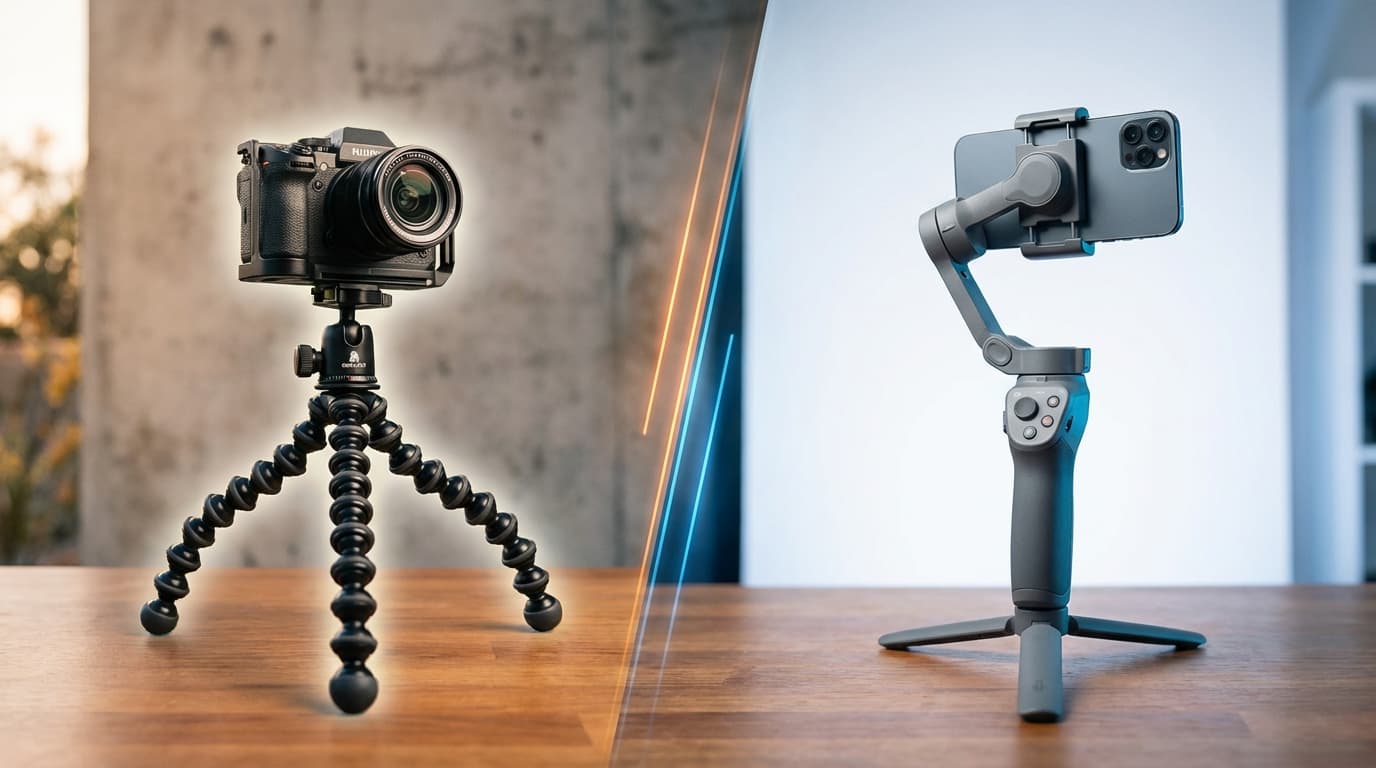
Gorilla Pod VS DJI Stabilizers: The Vlogging Battle
This is the debate raging in the backpacks of content creators worldwide. In one corner, the mechanical simplicity and legendary versatility of the Gorilla Pod. In the other, the almost magical smoothness and technological sophistication of DJI stabilizers. As a content creator and passionate traveler, I've used both extensively in the field, sometimes in far-from-ideal conditions. And while the current trend leans heavily toward motorized gimbals, I must admit: my heart, and more importantly, my head, remain loyal to the good old Gorilla Pod.
Why? The answer comes down to one word: battery. Or rather, the lack of one. In this article, we'll dive into the heart of this duel. We're not just going to compare spec sheets, but analyze these tools from the most critical angle for a traveler: their reliability and durability in the face of the uncertainties of the road. This is a comparison born from experience, where peace of mind often outweighs technical perfection.
The Gorilla Pod: In Praise of Mechanical Reliability
The Gorilla Pod, popularized by the brand JOBY, is much more than a simple mini-tripod. It's a true Swiss Army knife for camera positioning. Its articulated, flexible legs can wrap around a branch, grip a railing, or simply stand stably on an uneven rock. Its design is disarmingly simple: plastic or aluminum ball joints that fit together, and that's it.
For me, after years of using it, its greatest strength has become obvious: it can't break down. It has no software to update, no battery to charge, no motor that can burn out in a light rain. This rock-solid reliability is one less thing to worry about when you're thousands of miles from home, focused on capturing the perfect moment.
Durability vs. Fragility: A Gorilla Pod Analysis
The term "fragility" might seem strange for an object I'm calling reliable. However, it has its limits, which are crucial to understand.
Strengths:
- Simple Design: Fewer components mean fewer things can go wrong. No electronics, no problem. It can take a beating, fall out of your bag, get covered in sand... a good cleaning is usually all it takes to get it back in working order.
- Quality Materials (for the originals): Genuine JOBY Gorilla Pods are made with high-quality ABS plastics and aluminum alloys for the more robust models (3K, 5K series). They are built to last.
- Resistance to the Elements: Rain, dust, sand, or mud won't stop it from working. A DJI gimbal, on the other hand, would hate these conditions.
Potential Weaknesses:
- Joint Wear: This is its only real weak point. Over time and with repeated handling (especially if you force the joints), the ball joints can lose their stiffness. The camera might then start to slowly "slip." In my experience, this happens after several years of heavy use, and it's a gradual process.
- Respecting the Max Payload: Using a Gorilla Pod 1K (rated for 1 kg) with a 2 kg DSLR is a recipe for disaster. It is imperative to choose the model that matches your gear.
| Gorilla Pod Pros | Gorilla Pod Cons |
|---|---|
| ✅ No battery required (ultimate reliability) | ❌ Passive stabilization only (no motion correction) |
| ✅ Extremely versatile (grips onto anything) | ❌ Joints can wear out over time |
| ✅ Lightweight and relatively compact | ❌ Requires manual adjustment for each shot |
| ✅ Discreet and quick to set up | ❌ Less effective for smooth tracking shots |
| ✅ Highly resistant to shocks and the elements | ❌ Stability depends on the gripping surface |
| ✅ Affordable | ❌ Cheap knock-offs are very fragile |
DJI Stabilizers: The Quest for Perfect Smoothness
DJI stabilizers (like the Osmo or Ronin series) are marvels of engineering. These "gimbals" or motorized gimbals use sensors and 3-axis brushless motors to actively compensate for the operator's movements. The result is video with cinematic smoothness, even when walking or running. The "wow" factor is undeniable, and they have transformed the quality of travel vlogs.
However, this perfection comes at a cost, and I'm not just talking about the purchase price. It relies on a complex ecosystem of batteries, motors, sensors, and software, all of which are potential points of failure.
Durability vs. Fragility: The Electronic Complexity
A DJI stabilizer is a sophisticated electronic device and must be treated as such.
Strengths:
- Build Quality: DJI is known for its quality materials. The stabilizers are dense, well-finished, and feel solid in hand.
- Locking Mechanisms: Recent models have locks on each axis, which protect them during transport and prevent the motors from straining.
Critical Weaknesses:
- The Electronics: This is the heart of the system and its greatest weakness. A drop, even a minor one, can damage a motor or sensor, rendering the device useless. The slightest bit of water or fine dust can be fatal.
- The Battery: This is the Achilles' heel. No battery, no stabilization. One of the worst stresses in digital nomad travel is realizing you forgot to charge your gear. A battery can also lose its charge capacity over time or simply fail, leaving you with a dead weight in your bag.
- Calibration: Every time you change a lens or add a filter, the stabilizer must be perfectly balanced. Improper balancing strains the motors, reduces battery life, and can damage them in the long run.
| DJI Stabilizer Pros | DJI Stabilizer Cons |
|---|---|
| ✅ Perfect active stabilization (cinematic look) | ❌ Completely dependent on its battery |
| ✅ Smart features (subject tracking, etc.) | ❌ Very fragile (electronics, motors) |
| ✅ Allows for complex camera movements | ❌ Sensitive to water, dust, and shocks |
| ✅ Gives videos a very professional look | ❌ Heavier and bulkier |
| ✅ Easy to use once calibrated | ❌ Calibration process can be tedious |
| ❌ Significantly more expensive |
The Verdict from the Field: Which One to Choose for Your Next Trip?
Let's put the two competitors head-to-head on the criteria that really matter for a traveler.
Criterion 1: The Battery - Freedom vs. Constraint
Here, the fight is one-sided. The Gorilla Pod offers total freedom. It's always ready. The DJI imposes the discipline of charging. This means one more charger and cable to pack, a routine to follow every night at the hotel, and the constant risk of forgetting. For a fan of minimalist travel, this is a major point.
- Winner: Gorilla Pod, by technical knockout.
Criterion 2: Fragility and Resistance to Mishaps
Imagine a hike in a surprise downpour, a trek in the Moroccan desert, or simply your bag falling off a bus's luggage rack. In 99% of these scenarios, the Gorilla Pod will come out unscathed. The DJI stabilizer, however, risks permanent failure. For trips off the beaten path, the mechanical durability of the Gorilla Pod provides an unparalleled peace of mind.
- Winner: Gorilla Pod.
Criterion 3: Stabilization Quality and Video Look
Let's be honest. If your only goal is to get perfectly smooth moving shots, nothing beats a gimbal. The passive stabilization of a Gorilla Pod (holding it with two hands, arms bent) can reduce micro-jitters, but it will never match the active correction of a motor. For tracking shots, subject following, or a cinematic look, the DJI is in another league.
- Winner: DJI Stabilizer.
Criterion 4: Versatility and Bulk
The DJI stabilizer does one thing, but it does it perfectly: stabilize motion. The Gorilla Pod, on the other hand, is a tabletop tripod, a selfie stick, a mount for a light or microphone, and a universal gripping system. It's often lighter and takes up less space when folded, a major asset for traveling light.
- Winner: Gorilla Pod.
My Final Choice: Reliability Over Perfection
As you've probably gathered, despite the spectacular results offered by DJI stabilizers, the Gorilla Pod remains my preference for the majority of my trips. The choice is a philosophical one: I prioritize reliability, simplicity, and versatility over battery-dependent technical perfection.
Knowing that my main stabilization tool will always work, no matter the conditions, wherever I am, without me having to worry about a power outlet, is a priceless freedom. It forces me to be more creative with my static shots and more stable with my movements, but it will never let me down.
Of course, the ideal choice depends on your style of travel and production. For a commercial project or a trip focused on producing highly polished videos, bringing a DJI can be justified. But for the vlogger-adventurer, the digital nomad, or simply someone who wants to capture memories without the mental overhead, the peace of mind offered by the Gorilla Pod is, in my opinion, unbeatable. It's one of my best travel tips when it comes to gear: choose durability.
Sources and References
To ensure the accuracy of the technical information and allow you to explore further, here are some official and reliable resources:
- JOBY: The official website of the creator of the Gorilla Pod. Ideal for comparing the different models (1K, 3K, 5K) and their respective payload capacities.
- DJI: The official DJI website, featuring detailed spec sheets for the latest stabilizers in the Osmo and Ronin series, as well as user manuals.
- DPReview (Digital Photography Review): A reference source for in-depth photo and video gear reviews, including comparisons and long-term durability analysis.