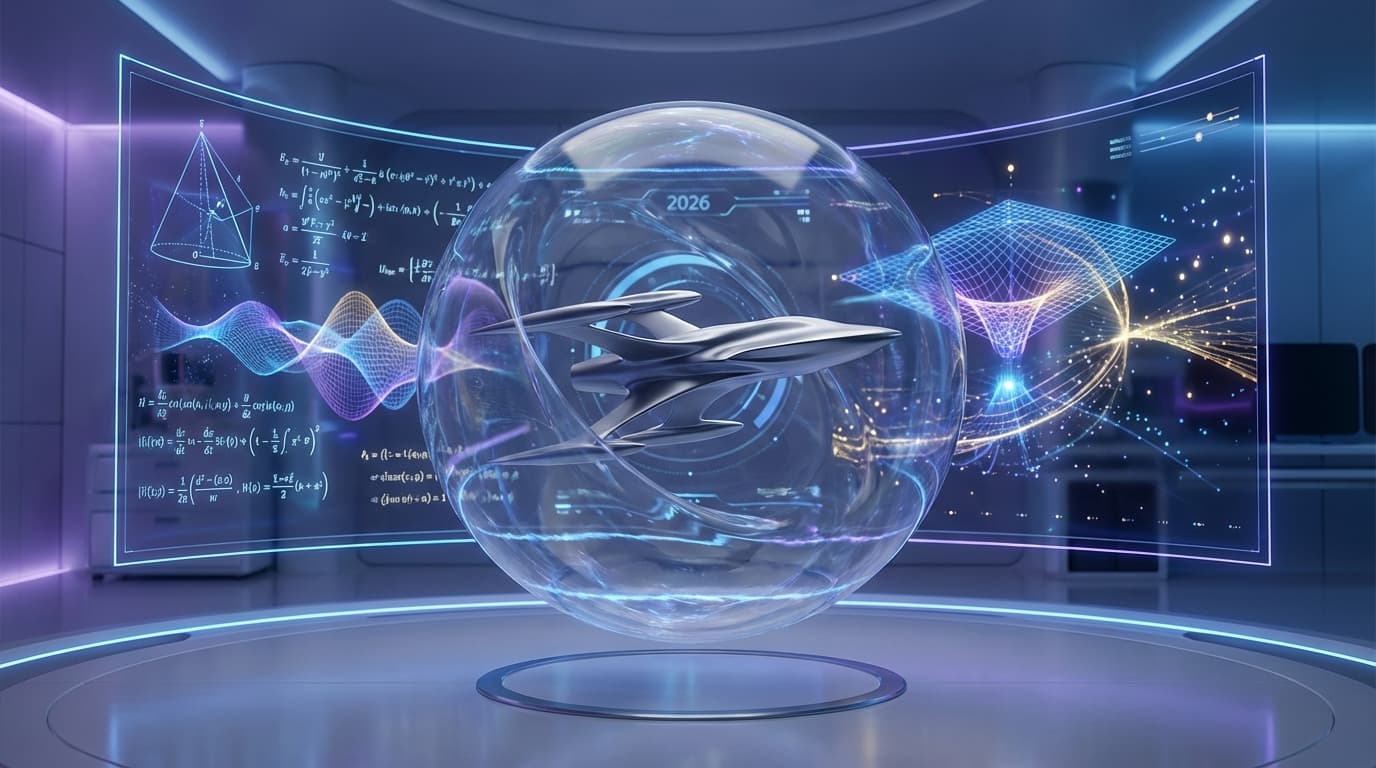
Interstellar travel, popularized by science fiction works like Star Trek, has long seemed confined to the realm of imagination. Yet, at the heart of theoretical physics, a bold concept persists: the Alcubierre drive. Far from being a mere fantasy, this "warp drive" is based on a valid mathematical solution to Einstein's general relativity equations. The idea is not to move through space at a prodigious speed, but to contract spacetime in front of a ship and expand it behind, creating a "bubble" that carries the ship along with it.
Until recently, the obstacles seemed insurmountable, particularly the cataclysmic energy requirements and the need for a mysterious "exotic matter" with negative energy. But the year 2026 marks a turning point. Several breakthroughs in fundamental research have revived interest in and credibility for this revolutionary mode of propulsion, lifting it from the limbo of impossibility and setting it on the path to plausibility.
A Refresher on the Fundamentals: The Mechanics of Spacetime Warping
Before diving into the breakthroughs of 2026, it's essential to understand the principle of the Alcubierre drive, proposed by Mexican physicist Miguel Alcubierre in 1994.
The Metric That Changes Everything
The Alcubierre drive is a purely mathematical construct. It is a "metric"—a way of measuring distances in spacetime—that is a perfectly legitimate solution to Einstein's equations. Imagine a surfer on a wave. The surfer doesn't swim faster than the ocean; they are carried by the wave itself. In the same way, a ship with an Alcubierre drive would be inside a local "warp bubble."
Inside this bubble, spacetime is flat, and the ship is technically at rest. It experiences no acceleration, no crushing G-forces, and, crucially, no time dilation effects. For the occupants, the journey would be instantaneous, while an outside observer would see the bubble moving at a speed potentially faster than light. This does not violate relativity, because it is spacetime itself that is moving, not the object traveling through it.
The Thorny Problem of Negative Energy
The concept's Achilles' heel has always been its theoretical fuel: exotic matter. To create the negative curvature of spacetime needed for expansion, the theory requires a negative energy density. This is a form of matter-energy that would have repulsive gravitational properties, a kind of anti-gravity.
The initial estimates were daunting. To create a bubble the size of a small spacecraft, an amount of negative energy equivalent to the mass of the planet Jupiter would be needed. Such a requirement made any practical application utterly unthinkable. It is precisely on this point that the research of 2026 has shed a new and spectacular light.
2026: The Revolution in Energy Models
The year 2026 will go down in the annals of fundamental physics as the year the negative energy wall began to crack. Two parallel lines of research converged to offer a radically new perspective.
Energy Requirements Reduced by Several Orders of Magnitude
In the spring of 2026, a joint publication by the Max Planck Institute and the French CEA sent shockwaves through the community. Building on the earlier work of Harold White at NASA, who had already proposed modifying the bubble's geometry to reduce energy needs, this new study went much further. Using complex simulations running on AI-enhanced supercomputers, the researchers demonstrated that an oscillating and dynamic warp bubble, rather than a static and rigid one, could be maintained with a drastically reduced amount of negative energy.
Instead of a thick shell, the 2026 model proposes a series of concentric, pulsating warp waves. This approach allows the negative energy density to be localized only where it is strictly necessary at any given moment.
The result is staggering: the energy requirements drop from the mass of a gas giant to that of a large asteroid, and then, in the most optimized models, to just a few hundred kilograms. Although creating negative-energy matter remains a colossal challenge, this reduction makes the problem theoretically approachable.
The Casimir Effect: A Physical Lead is Confirmed
Theory is one thing, but what about practice? The other major breakthrough of 2026 came from the experimental world. The only known physical phenomenon that produces a form of negative energy density is the Casimir effect. This quantum effect, verified in the lab, shows that two parallel conductive plates placed very close to each other in a vacuum experience an attractive force. This force is due to the space between the plates restricting quantum vacuum fluctuations, creating a region where the energy density is slightly lower than that of the surrounding vacuum—hence, it is negative.
In October 2026, a team at Caltech published results showing for the first time that it was possible to manipulate and stabilize a "Casimir cavity" using metamaterials and complex electromagnetic fields. They succeeded in maintaining a measurable, albeit tiny, area of negative energy density for several nanoseconds. This is a fundamental proof of concept: we are no longer limited to passively observing the effect; we are beginning to be able to engineer it. This opens a path, admittedly a long and winding one, toward the controlled production of the "fuel" needed for a warp drive.
Stability and Control of the Bubble: The New Paradigms
Creating the bubble is one thing; making it safe and steerable is another. Earlier models raised terrifying questions about stability and the potentially cataclysmic side effects of such a device.
The "Firewall" Is No Longer Inevitable
One of the most troubling problems was the accumulation of particles and radiation at the front of the bubble. According to some theories, upon deceleration, all this accumulated energy would be released at once, annihilating not only the ship but also its destination. This was known as the "firewall" problem.
The 2026 simulations, which model a dynamic and "porous" bubble, offer an elegant solution. The bubble's wall is not an impermeable boundary. The models suggest that it interacts with the interstellar medium in a way that deflects the majority of high-energy particles rather than accumulating them. Particles that do enter the bubble do so with low enough energy to be managed by conventional shielding. This discovery transforms the Alcubierre bubble from a potential bomb into a potentially viable vehicle.
The First Dynamic Control Models
How do you turn the drive on? How do you turn? And most importantly, how do you stop? Until now, the Alcubierre metric described a state of being, not a process. In 2026, theoretical physicists at the University of Geneva published the first complete mathematical framework for controlling a warp bubble.
Their equations describe how to modulate the fields that generate the bubble in order to:
- Initiate the warp: Smoothly transition from flat spacetime to curved spacetime.
- Accelerate and decelerate: Modify the bubble's speed by changing the amplitude of the contraction and expansion.
- Maneuver: Create an asymmetry in the bubble to change direction.
- Dissipate the bubble: Return to flat spacetime in a controlled manner, without a destructive release of energy.
This work transforms the Alcubierre drive from a static concept into a dynamic and controllable propulsion system. It’s the leap from a picture of a car to its full engineering blueprints.
Implications for the Future of Space Exploration
These advances, though purely theoretical and at an embryonic experimental stage, completely redefine the horizons of space exploration. They lay out a roadmap that, for the first time, seems to lead somewhere concrete.
A Solar System on Our Doorstep
Let's forget faster-than-light speeds for a moment. A "slow" version of the Alcubierre drive, moving at just 10% of the speed of light (0.1c), would revolutionize our own solar system. Without the constraints of time dilation and extreme acceleration, such a ship could make the following journeys:
- Earth to Mars: Less than 48 hours, compared to the current 6 to 9 months.
- Earth to Jupiter: About one week.
- Earth to Voyager 1 (the most distant human-made object): Less than 10 days.
This would make the solar system as accessible as the Earth's continents were in the 20th century. Manned missions, infrastructure deployment, or the intervention of 2026 humanoid robots for repairs would become simple logistical operations.
The Research Timeline for the Next Decade
The breakthroughs of 2026 have catalyzed an international research effort. The goals are no longer to prove that it's possible, but to figure out how to do it. The roadmap proposed by research consortiums is ambitious and stands in contrast to the more mature technologies on the 2026 space flight schedule, which still rely on chemical propulsion.
Here are the key steps envisioned:
- 2028-2030: Construction of a large-scale laser interferometer to attempt to detect infinitesimal spacetime distortions generated in a laboratory.
- 2032-2035: Development of quantum metamaterials capable of sustaining larger and more durable Casimir cavities.
- 2040: Launch of a dedicated space probe, the "Warp Program Precursor," whose mission will be to test the creation of a measurable micro-distortion in the vacuum of space under real conditions.
The road ahead is still extraordinarily long. But in 2026, the Alcubierre drive crossed a decisive threshold. It has moved from a mathematical curiosity to an active and promising field of research, carrying with it the promise of a future where the stars are no longer just points of light in our sky, but true destinations.