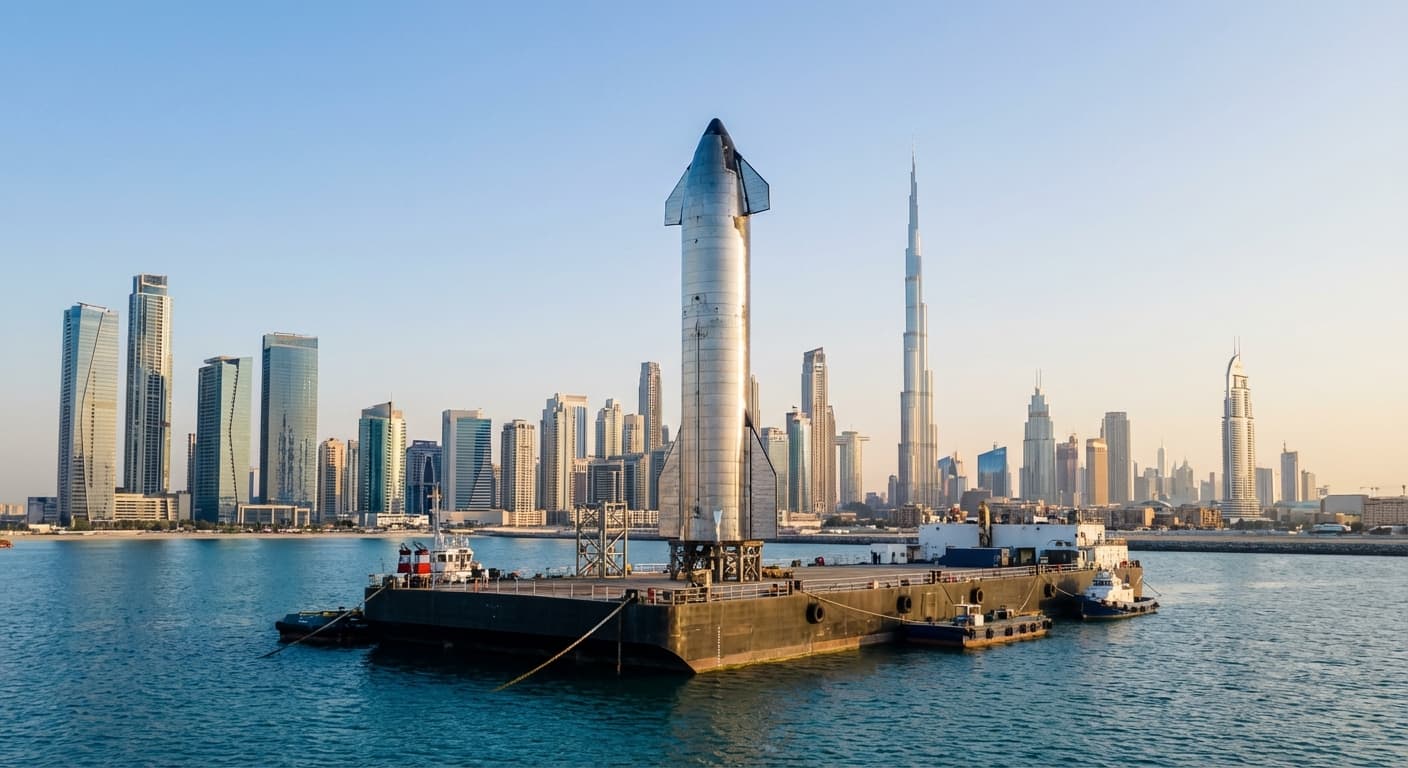
The year 2026 is shaping up to be a turning point in space exploration, with SpaceX's Starship at the center of attention. After years of spectacular iterative tests, the super-heavy launcher is preparing to enter its operational phase. Between humanity's return to the Moon with the Artemis III mission and the massive deployment of the next generation of Starlink satellites, the flight manifest looks as ambitious as it is revolutionary. This provisional schedule paints a picture of a year that could well redefine our access to space.
2026: A Pivotal Year for SpaceX and Starship
While previous years were marked by Integrated Flight Tests (IFTs) aimed at validating each stage of the launch, from separation to atmospheric reentry, 2026 symbolizes the transition to maturity. The goal is no longer just to prove that the system works, but to make it work regularly, reliably, and at a pace never before seen for a launcher of this size.
The stakes are colossal and focus on two major areas:
- Supporting NASA's Artemis program: The Starship, in its HLS (Human Landing System) version, is the central element that will allow astronauts to land on the lunar surface for the first time since 1972. The success of this mission depends on a series of complex and perfectly orchestrated launches.
- Accelerating Starlink deployment: SpaceX's internet constellation needs Starship's massive volume and payload capacity to launch its larger, more powerful V2 satellites, and thus achieve optimal global coverage.
Beyond these two pillars, 2026 should also see the first true commercial missions for third-party clients, whether for geostationary satellites or unique scientific payloads.
Provisional Starship Launch Schedule for 2026
It's crucial to note that this schedule is a projection based on the public goals of SpaceX and NASA. Dates are subject to change depending on technical progress, regulatory certifications, and mission requirements. The iterative nature of SpaceX's development implies constant flexibility.
| Mission (Name/Objective) | Launch Date (Estimated) | Launch Site | Payload / Crew | Status / Notes |
|---|---|---|---|---|
| Starlink Group 8-1 | January 2026 | Starbase, Texas | ~100-150 Starlink V2 Mini or V3 satellites | First operational launch of the year, focused on cadence. |
| HLS Uncrewed Test Landing | February 2026 | KSC, Florida | Uncrewed Starship HLS (lander) | Uncrewed demonstration mission to validate lunar landing before Artemis III. Crucial. |
| Tanker Flight 1 (Artemis III) | March 2026 | KSC, Florida | Propellants (Liquid Methane and Oxygen) | First in a series of ~10-15 refueling flights for the orbital depot. |
| Starlink Group 8-5 | March 2026 | Starbase, Texas | ~100-150 Starlink V2 Mini or V3 satellites | Continued deployment of the constellation. |
| Tanker Flights 2-5 (Artemis III) | April - May 2026 | KSC, Florida | Propellants | Ramping up the pace of refueling flights. Mastering cryogenic transfer is key. |
| 'Eutelsat-X' Commercial Mission | June 2026 | KSC, Florida | Heavy geostationary telecommunications satellite | Example of a commercial mission, demonstrating Starship's ability to launch next-generation payloads. |
| Tanker Flights 6-10 (Artemis III) | July - August 2026 | KSC, Florida | Propellants | Finalizing the fill-up of the propellant depot in low Earth orbit (LEO). |
| Starlink Group 9-2 | September 2026 | Starbase, Texas | ~100-150 Starlink V2 Mini or V3 satellites | Maintaining the pace to densify the Starlink network. |
| Starship HLS Launch (Artemis III) | October 2026 | KSC, Florida | Starship HLS (lander) intended for the Artemis III crew | The lander is launched and meets the propellant depot to refuel before heading to the Moon. |
| Polaris III / Commercial Crewed Flight | November 2026 | KSC, Florida | Commercial crew | Potential mission from the Polaris Program, aimed at testing technologies like extravehicular activities (EVAs). |
| Artemis III (Lunar Landing) | December 2026 | Lunar Orbit | NASA crew | Rendezvous with the Orion capsule, historic landing on the lunar South Pole. The pinnacle of the year. |
Breaking Down the Key Missions of 2026
Some missions planned for 2026 are much more than simple launches; they represent major technological and symbolic leaps.
Artemis III: Humanity's Return to the Moon
The Artemis III mission is undoubtedly the most anticipated space event of the decade. Starship's role is absolutely central and is broken down into an orbital choreography of unprecedented complexity:
- Creating an orbital fuel depot: Even before the crew leaves Earth, SpaceX will need to launch a "depot" version of Starship. This will be followed by a fleet of "tanker" Starships that will fill it with hundreds of tons of liquid methane and oxygen.
- Launching the lander (HLS): Once the depot is full, SpaceX will launch the Starship HLS, the version configured for astronauts, which will dock with the depot to refuel.
- Transit to lunar orbit: The HLS will then use this fuel to leave Earth's orbit and place itself in orbit around the Moon, where it will await the crew's arrival.
- Rendezvous and Landing: The astronauts, arriving via NASA's Orion capsule, will transfer to the Starship HLS to descend and land on the lunar surface.
This ambitious plan relies entirely on SpaceX's ability to master the transfer of cryogenic propellants in zero gravity, a technology that has never been achieved on this scale.
Massive Deployment of Starlink Satellites
For SpaceX's finances and long-term vision, the Starlink missions are just as vital. The V2 (or V3) version of the satellites is too large and heavy to be launched economically by the Falcon 9. Starship is a game-changer, capable of carrying more than a hundred of these new satellites in a single flight, compared to about twenty for the Falcon 9.
In 2026, the goal will be to achieve a near-monthly launch cadence for Starlink. This will not only improve coverage and bandwidth for current users but also provide essential global connectivity for millions of people, transforming the daily lives of many digital nomad travelers in the process.
The Dawn of Commercial and Scientific Flights
Starship's payload bay capacity (over 100 tons to low Earth orbit) opens up unprecedented possibilities. Scientists are already dreaming of placing space telescopes the size of Hubble in it, but built and launched for a fraction of the cost. Telecommunication satellite operators, for their part, will be able to design much more powerful platforms. 2026 should see the first realizations of this potential, with one or two flights dedicated to external clients, demonstrating the economic viability of SpaceX's model. Artists and engineers are even using 2026 AI image generators to begin visualizing these revolutionary missions and designing the payloads of tomorrow.
Technological and Logistical Challenges to Overcome
Despite the prevailing optimism, the road to achieving this schedule is fraught with challenges. SpaceX must still overcome several major hurdles.
The Reliability of the 33 Raptor Engines
The Super Heavy, Starship's first stage, is powered by 33 Raptor engines. Ensuring their simultaneous and flawless operation on every launch is a statistical and technical challenge. A single engine failure can be tolerated, but a cascade failure would be catastrophic. The 2026 cadence will demand proven reliability and flawless engine production.
Orbital Refueling
As mentioned, this is the main technological bottleneck for lunar and, eventually, Martian missions. Transferring hundreds of tons of cryogenic liquids from one spacecraft to another in zero gravity, with minimal boil-off, is an extremely complex exercise. Dedicated demonstration flights will be necessary before it can be used for the Artemis III mission.
Launch Cadence and Infrastructure
Supporting such a schedule requires more than just reliable rockets. It requires ground infrastructure capable of assembling, integrating, and launching Starships at a steady pace. This includes mass production at Starbase, the finalization of the launch tower at the Kennedy Space Center (LC-39A), and seamless logistics between the two sites.
Beyond 2026: What is the Vision for Starship?
If 2026 is the year it all comes together, it is only one step in Elon Musk's vision. Once reliability and cadence are demonstrated, the goals will become even more ambitious. Robotic missions to Mars could be considered as early as the 2028/2029 launch window, paving the way for the first human missions. The construction of permanent lunar bases, the assembly of large structures in orbit, and planetary defense will become tangible possibilities.
The space ecosystem will also be transformed, with the emergence of new industries taking advantage of this facilitated access to orbit. One of the most futuristic visions is the use of 2026 humanoid robots to assist astronauts and build the first infrastructures on the Moon and Mars, a synergy between robotics and space exploration that seemed like science fiction just a few years ago.