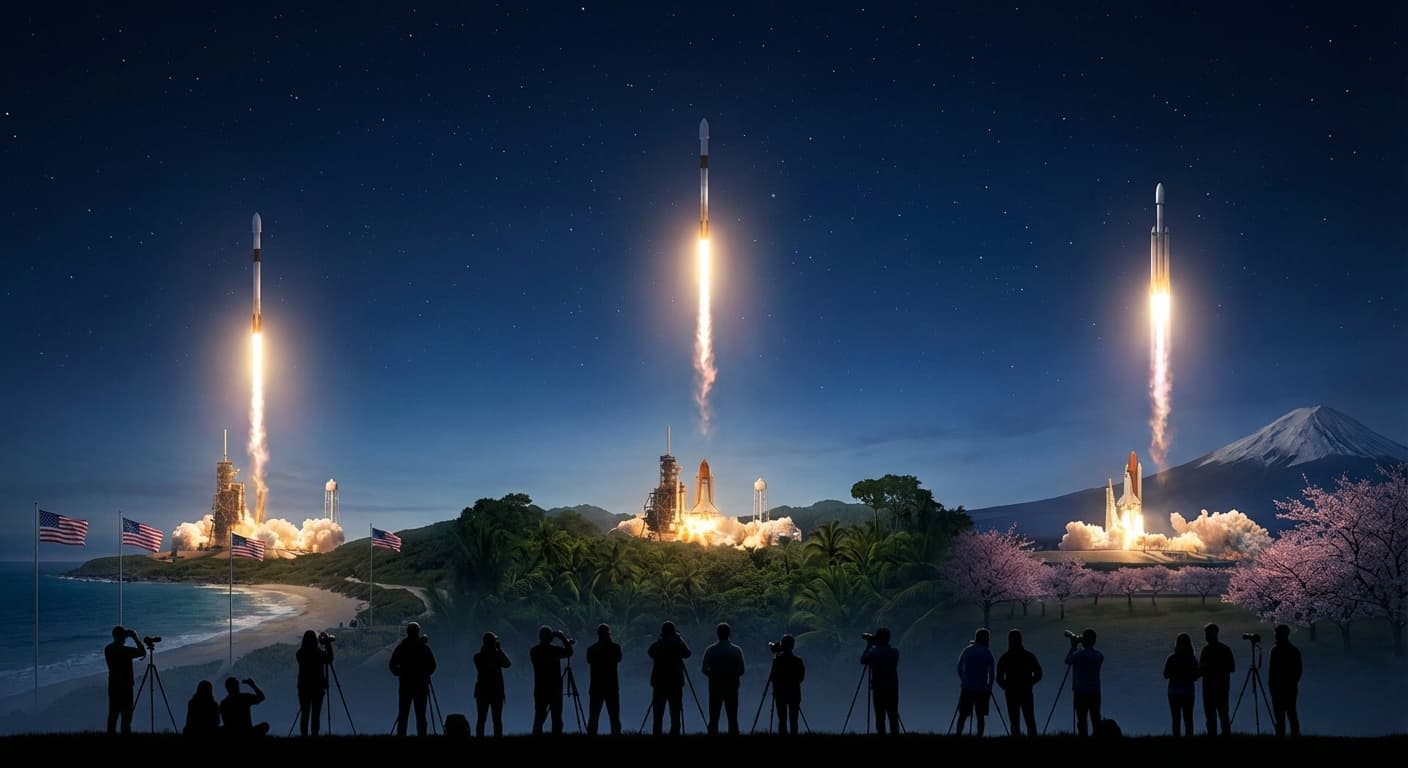
Witnessing a rocket launch is an experience that stays with you for a lifetime. The sound that vibrates every fiber of your being, the blinding light that tears through the sky, and the awareness of witnessing a moment where humanity pushes its boundaries... It's an all-encompassing spectacle, both technological and profoundly human. As an engineer passionate about space exploration, I have always been fascinated by these events. In our experience, preparing for such a trip requires specific planning. This guide aims to give you everything you need to plan your visit to three of the most iconic launch pads in the world: Florida in the United States, French Guiana, and Tanegashima Island in Japan.
Witnessing a Launch in the USA: At the Heart of Space History (Florida)
Florida's "Space Coast" is undoubtedly the most famous place to watch launches. This is where the Apollo missions took off for the Moon and where the space shuttles made history. Today, it's the epicenter of activity for SpaceX, NASA with its Artemis program, and other players like ULA.
Why the "Space Coast"?
The Kennedy Space Center (KSC) and the Cape Canaveral Space Force Station are historic and highly active sites. The frequency of launches, especially Starlink by SpaceX, offers numerous opportunities throughout the year. The tourist infrastructure is also very well-developed, which makes organizing a trip much easier.
Where and How to See a Launch?
There are two main approaches to the experience:
1. The Official Experience: The Kennedy Space Center Visitor Complex This is the most structured and immersive option. The KSC offers specific tickets for launch days, providing access to prime viewing areas.
- Apollo/Saturn V Center: Located about 6 to 8 km (4 to 5 miles) from the launch pad, this is often the closest viewpoint accessible to the public. The view is breathtaking, with the sound of the launch reaching you with a slight delay. The experience is enhanced by live commentary from experts.
- The Banana Creek Viewing Area: Another popular spot within the complex, offering a clear view of several launch pads.
Our pro tip: Buy your tickets well in advance, especially for high-profile missions like a Starship launch or a crewed mission. Tickets sell out extremely fast.
2. Public Viewing Spots (Free or Low-Cost) For a more local approach, many parks and beaches offer spectacular views.
- Jetty Park (Port Canaveral): An excellent choice. You can see the rocket rise over the ocean. There is a fee for the park (per vehicle), and it's essential to arrive several hours in advance to get a good spot.
- Max Brewer Bridge (Titusville): A very popular and free viewpoint. The view of the KSC launch pads is direct. Traffic is closed off before the launch, turning the bridge into a massive observation deck.
- Space View Park (Titusville): This park is dedicated to space history and offers a more distant but still decent view, with NASA audio broadcast over loudspeakers.
Practical Tips for Florida
- Flexibility: Launches are often postponed ("scrubs"). Always plan for one or two buffer days in your schedule.
- Equipment: Bring folding chairs, water, sunscreen, and binoculars. The wait can be long.
- Traffic: Expect massive traffic jams before and especially after the launch. Patience is your best friend.
The Guiana Space Centre (CSG): Europe's Gateway to Space
Located in Kourou, French Guiana, the CSG is Europe's spaceport. Its position near the equator is a major technical advantage, offering an extra "boost" thanks to the Earth's rotation. This is where the Ariane, Vega, and formerly Soyuz rockets launch from.
A Unique and Free Experience
Unlike the KSC, watching a launch at the CSG is completely free. However, it requires mandatory pre-registration on the CSG/CNES website. Spots are limited and in high demand.
The Official Observation Sites
The CSG offers several observation sites, located at different distances from the launch pad. During our visit, we noticed that each site offers a different atmosphere.
- Ibis Site: About 5 km away, it is often reserved for official guests and the press.
- Agami Site: The closest site accessible to the general public by registration (about 7.5 km). The experience here is intense. You can really feel the vibrations, and the sound is impressive.
- Carapa Site: Further away (about 15 km), it accommodates a larger number of people and is often the default site offered during registration. The atmosphere there is more family-friendly, but the rocket appears smaller.
Our Recommendations for the Guiana Experience
- Plan Ahead: Register as soon as booking opens, usually a few months before the launch. Regularly check the 2026 space flight schedule to plan.
- Logistics: Kourou is a small town. Book your accommodation and rental car well in advance, as everything gets booked up solid on launch days.
- Immersion: Take the opportunity to discover French Guiana! The tour of the space center itself is fascinating, and a dugout canoe trip on the Kourou River or an excursion to the Salvation's Islands (Îles du Salut) perfectly round out the trip.
Japan and Space: Precision and Nature at the Tanegashima Space Center (TNSC)
For a radically different experience, Japan offers a spectacular setting. The Tanegashima Space Center (TNSC), operated by JAXA, is often described as the most beautiful spaceport in the world, nestled on a lush, subtropical island.
An Exceptional Setting
The TNSC is located at the southeastern tip of Tanegashima Island, south of Kyushu. The contrast between the high space technology and the surrounding wild nature, with its white sandy beaches and turquoise waters, is striking.
Watching a Japanese Launch
For security reasons, it's not possible to enter the TNSC on launch day. However, JAXA has set up several official and free observation points in the vicinity, offering spectacular views.
- Uchugaoka Park: This is the main and most popular viewpoint. It is located on a hill and offers a panoramic view of the launch pads. It is equipped with large screens and speakers broadcasting the countdown.
- Hase Park: Further south, this park offers a side-on view of the launch. From our analysis, this is an excellent spot for photography, as the rocket's trajectory is beautifully framed above coastal rock formations.
Tips for a Successful Trip to Tanegashima
- Access: The island is accessible by high-speed ferry from Kagoshima or by plane. Renting a car is essential for getting around the island and reaching the observation points.
- Planning: Launches of the H-IIA or H3 rocket are less frequent than those of SpaceX. You must therefore plan your trip specifically around a launch window confirmed by JAXA.
- Language Barrier: Outside of the main tourist areas, English is not widely spoken. Having a translation app can be very helpful. It's a perfect destination for a digital nomad trip in search of authenticity.
Whether you choose the historic excitement of Florida, the equatorial adventure in French Guiana, or the serene beauty of Japan, witnessing a space launch is a promise of wonder. It's a direct connection to one of humanity's greatest dreams: reaching for the stars.
Sources and References
To ensure up-to-date and reliable information, we recommend always consulting official sources before planning your trip.
- Kennedy Space Center Visitor Complex: The official site for buying tickets and checking launch dates in Florida.
- National Centre for Space Studies (CNES) - Guiana Space Centre: The official source for registering for launches in Kourou and getting the latest information.
- Japan Aerospace Exploration Agency (JAXA): The website of the Japanese space agency, providing the launch schedule and information on viewing points in Tanegashima.